
Last updated October 16, 2026
 AC repair
 Furnace & heating
 Heat pumps
 Ductless mini splits
 Carrier
 Trane
Trane Goodman
Seasonal tune-up and full diagnostic on your Carrier, Trane, or Goodman system - readings shown to you before any repair is proposed
Diagnosis first, numbers second - you approve the repair price before a single part goes in.
Get your free estimateAC Repair Maintenance Checklist for Jacksonville Homeowners
Here’s the thing most Jacksonville homeowners don’t realize until it’s 92 degrees on a Saturday in July: the number-one cause of AC failure calls between June and August isn’t a broken compressor. It’s a drain line clogged by algae growth that the homeowner’s “annual tune-up” never specifically addressed because it was scheduled in February, when algae wasn’t active yet. A generic maintenance checklist gives you false confidence. The tasks that actually prevent breakdowns in Jacksonville are timed to specific humidity spikes, storm seasons, and pollen windows. This guide tells you exactly what to check, when to check it, and what you can safely handle yourself versus what Florida law reserves for a licensed technician. We’re a Jacksonville HVAC company offering AC Repair, and we’ve built this checklist around what fails first in Northeast Florida, not a calendar printed in Chicago.
Styles & brands we work with
Quick Answer
An effective AC maintenance checklist for Jacksonville homeowners is season-timed, not calendar-timed: flush the condensate drain line with an algae-preventing solution every 60 to 90 days between March and October, replace or clean filters monthly during peak pollen and again after hurricane debris events, inspect exterior coil fins and refrigerant line insulation in late spring before storm season, and schedule a professional system inspection each March before the humidity spike hits. For a deeper dive, see The Complete Guide to HVAC in Jacksonville. Most seasonal failure points in Jacksonville are drain-related, filter-related, or UV-degradation-related, and all three are preventable with the right timing.
Table of Contents
- Why Jacksonville AC Maintenance Is a Timing Problem, Not a Task Problem
- The Month-by-Month Jacksonville AC Maintenance Checklist
- The Drain Line Flush Protocol: Jacksonville’s Most Overlooked Repair Preventer
- Refrigerant Line Insulation: What Jacksonville’s Sun Does to Your Line Set
- What You Can Safely Do Yourself vs. What Florida Law Requires a Licensed Technician to Handle
- How to Document Maintenance So It Protects Your Warranty and Supports Resale Disclosure
- The Post-Hurricane and Severe Storm AC Checklist
- Common Mistakes to Avoid
- When to Call a Professional
- Frequently Asked Questions
- The Bottom Line
Why Jacksonville AC Maintenance Is a Timing Problem, Not a Task Problem
Most AC maintenance checklists you find online were written for a national audience. They say things like “clean your condenser coils in spring” and “check your thermostat settings in fall.” That advice isn’t wrong, exactly. It’s just not tuned to what actually happens to air conditioning equipment in Northeast Florida. Jacksonville’s climate creates three distinct stress periods for residential HVAC systems, and each one demands a different set of checks.
The first stress period is pollen season. Starting in late February and running through April, Jacksonville’s oak, pine, and cedar pollen load is among the heaviest in the country. That pollen doesn’t just make your car yellow. It coats your outdoor condenser coil, reducing airflow across the coil and forcing the system to work harder to reject heat. It also loads up your return air filter far faster than the standard “change every 90 days” advice assumes.
The second stress period is the humidity spike. By May, Jacksonville’s dew points climb into the 70s and stay there through October. Your AC isn’t just cooling air during these months. It’s removing gallons of water from the air every day. All that condensed water flows through a drain line that is warm, dark, and wet, which is a perfect environment for algae. Once algae starts growing in the drain line, it builds up until the line blocks, the drain pan overflows, and water backs up into the system or spills into your ceiling or closet. This is the single most common avoidable repair we see in Jacksonville during summer.
The third stress period is storm season. From June through November, Jacksonville faces the possibility of tropical storms and hurricanes. High winds drive debris into outdoor units, heavy rain floods condensate drains and electrical disconnects, and power surges stress capacitors and contactors. A unit that ran fine in May can fail in August, not because of age, but because storm debris restricted airflow or a surge weakened an electrical component.
If you schedule maintenance around these three stress periods instead of around a generic calendar, you prevent the failures that actually happen in Jacksonville. That’s the difference between a checklist that makes you feel responsible and a checklist that keeps your AC running.
The Month-by-Month Jacksonville AC Maintenance Checklist
Here is the full month-by-month breakdown. You don’t need to do everything on this list every month. The point is to do the right things at the right time. Each section below explains what to do, how to do it safely, and when to call a professional instead.
January and February: The Low-Load Check
Jacksonville winters are mild, which means your AC may not run for weeks at a time if you don’t have a heat pump. That’s actually a risk. Components that sit idle for long periods can develop issues that don’t show up until the first hot day. During January and February, do the following:
- Run the system in cooling mode for 15 minutes. Set the thermostat five degrees below room temperature and confirm cold air comes from the registers. This catches early failures before you need the system for real.
- Check the outdoor unit for debris. Winter winds can blow leaves, pine straw, and trash against the condenser coil. Clear a two-foot radius around the unit.
- Inspect the drain line opening. If you have a drain line access point near the indoor air handler, look for standing water or slime. A little algae in February becomes a full clog by June.
- Replace the air filter. Even if it doesn’t look dirty, February is a good reset point before pollen season starts.
March: The Pre-Pollen Professional Inspection
March is the most important month for Jacksonville AC maintenance. This is when you want a licensed technician to do a full pre-season inspection, before the humidity arrives and before service schedules fill up. The inspection should include:
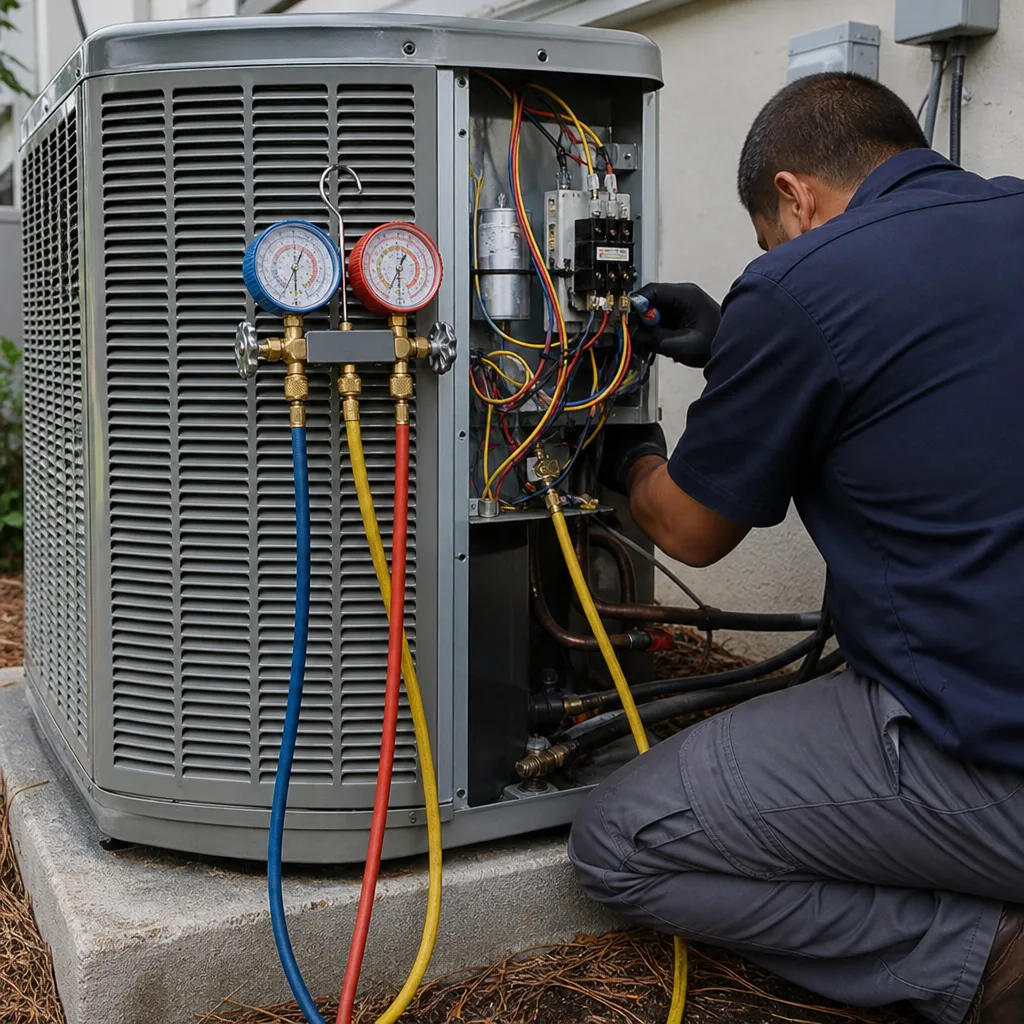
- Capacitor and contactor testing: these are the most common electrical failure points on a Jacksonville AC system, in our experience
- Refrigerant level check: a system that is even slightly low on refrigerant will struggle once outdoor temperatures pass 90
- Coil cleaning: both the evaporator coil inside and the condenser coil outside should be cleaned before the heavy load months
- Drain line flush and algae treatment: this is the single highest-value item on the list, and we cover the specifics in the next section
- Thermostat calibration: a thermostat that reads three degrees off will cost you money all summer
If you only do one thing on this entire guide, make it a professional inspection in March. It costs less than a repair call in August, and it gives you a written record of your system’s condition before peak season.
April: The Post-Pollen Filter Swap
By mid-April, pollen season is winding down in Jacksonville. Your air filter has been doing heavy work for six to eight weeks. Even if it doesn’t look clogged, the fine pollen particles load up the filter media and restrict airflow. Here’s the specific guidance:
- Replace the filter in late April, even if you replaced it in February. Pollen season shortens filter life dramatically.
- If you use a washable filter, wash it thoroughly and let it dry completely before reinstalling. A damp filter grows mold.
- Consider upgrading to a MERV 8 or MERV 11 filter for the spring and summer months if you have allergy concerns. Higher MERV ratings filter more pollen but can restrict airflow, so check with a technician before jumping to MERV 13.
- Visually inspect the outdoor coil. Pollen builds up on condenser fins the same way it does on your car. If the fins are coated yellow, brush them gently with a soft brush or schedule a professional coil cleaning.
May through September: The Humidity Season Protocol
These five months are when your AC works hardest in Jacksonville. During this stretch, do the following every 30 to 45 days:
- Flush the drain line. The full protocol is below, but the short version is: pour the right solution into the drain line access point every 60 to 90 days, or monthly if you’ve had clogs before. This is the highest-impact preventive task on this entire checklist.
- Check the drain pan. If your indoor unit has a visible drip pan, look for standing water. If you see water, the drain line is already partially clogged. Address it before it overflows.
- Listen for unusual sounds. A hissing sound near the indoor unit can indicate a refrigerant leak. A rattling sound from the outdoor unit can indicate a failing fan motor or loose debris. Catch these before they become breakdowns.
- Monitor your indoor humidity. If your system is cooling but not dehumidifying, something is wrong. A properly functioning Jacksonville AC should keep indoor relative humidity between 45% and 55% during summer. If you’re seeing 60% or higher, the system is short-cycling, low on refrigerant, or oversized for the space.
- Keep the outdoor unit clear. Grass clippings from mowing can coat the condenser coil and reduce airflow. Trim vegetation back at least two feet in all directions.
October: The Post-Hurricane Debris Check
Once hurricane season winds down, do a thorough exterior inspection. The full post-storm checklist is in its own section below, but the key points are: check for debris lodged in the condenser coil, inspect the refrigerant line insulation for storm damage, and make sure the outdoor unit is level after heavy rain. Units can shift on saturated ground, and an unlevel condenser stresses the compressor.
November and December: The Idle Season Prep
As temperatures drop, your AC gets a break. But Jacksonville’s mild winters mean the system never fully hibernates. Before you forget about the AC entirely, do these two things:
- Cover or clear the outdoor unit. If you use a cover, use one designed for AC condensers that allows airflow. A fully sealed cover traps moisture and accelerates rust. Or simply keep the area clear of falling leaves.
- Run the system one final time in cooling mode for 10 minutes to confirm it still works. Finding a problem in November is much better than finding it on the first hot day in April.
The Drain Line Flush Protocol: Jacksonville’s Most Overlooked Repair Preventer
Let’s talk about the drain line in more detail, because this is the task that separates Jacksonville homeowners who have reliable AC from those who don’t. Every air conditioner produces condensation. In Jacksonville’s humidity, a typical 3-ton system can remove five to ten gallons of water from the air per day. All of that water exits through a PVC pipe, usually three-quarter inch in diameter, that runs from the indoor air handler to either a floor drain, a utility sink, or the outside of the house.
That pipe is always wet on the inside. It’s dark. It’s warm. It’s the textbook environment for algae growth. Once algae starts growing, it forms a slimy biofilm on the pipe walls. That biofilm catches dust, dirt, and debris, and the pipe slowly narrows. Eventually, it blocks entirely. When the line blocks, the condensate has nowhere to go. The drain pan fills, and the water either triggers a float switch that shuts down the system or overflows into your ceiling, walls, or closet floor.
Here’s the protocol we recommend for Jacksonville homeowners:
- Locate the drain line access point. It’s usually a PVC pipe with a cap on top, located near the indoor air handler. If you can’t find it, a technician can point it out during your next service visit.
- Mix the right solution. Use one part white vinegar or a commercial condensate drain treatment to one part warm water. Avoid bleach. Bleach can damage PVC over time and does not prevent algae regrowth effectively in our experience. If you want the strongest option, use a commercial treatment specifically labeled for condensate drain lines, available at most Jacksonville hardware stores.
- Pour the solution slowly into the access point. Pour about two cups. Let it sit for 20 to 30 minutes. The solution needs contact time to break down the biofilm.
- Flush with clean water. After the solution sits, pour another cup or two of clean water through the line to rinse loosened debris out the other end.
- Repeat every 60 to 90 days from March through October. If your system has clogged before, do it monthly. Homes near the St. Johns River, in Ortega, or in other high-humidity pockets of Jacksonville tend to need more frequent flushing.
If the line is already clogged when you check it, a cup of vinegar won’t fix it. You need a wet-dry vacuum on the exterior drain line outlet, or a professional drain line clearing. If water is already backing up, turn the system off and call a Jacksonville AC repair professional before the overflow causes water damage.
Refrigerant Line Insulation: What Jacksonville’s Sun Does to Your Line Set
This is a maintenance item that almost no generic checklist mentions, and it’s one of the most common things we point out during service calls in Jacksonville. The refrigerant line set runs from your outdoor condenser to your indoor evaporator coil. The larger of the two copper lines, called the suction line, carries cold refrigerant back to the compressor. In a properly functioning system, that line is wrapped in foam insulation, typically black or gray, called armaflex.
That insulation does two jobs. First, it prevents the cold refrigerant from absorbing heat before it reaches the compressor, which keeps the system efficient. Second, it prevents condensation from forming on the cold copper pipe. In Jacksonville’s humidity, an uninsulated suction line sweats constantly. That moisture drips, corrodes the copper, and eventually causes a refrigerant leak.
The problem is that Jacksonville’s sun destroys that insulation. UV radiation breaks down the foam, especially on the portion of the line set that runs outside the house. After five to seven years of Florida sun, the insulation often looks like this: faded, cracked, crumbling, or missing in sections. Sometimes it’s held together with electrical tape because a previous homeowner or handyman tried to patch it. The damage is worst on west-facing and south-facing wall runs, where the sun hits directly for hours each day.
Here’s what to check, and when:
- Inspect the exposed line set insulation every spring, before storm season. Walk the exterior of the house and look at every visible inch of the line set.
- If the insulation is cracking, faded, or missing, the fix is not duct tape. It’s either a professional replacement of the armaflex with UV-resistant insulation, or a protective wrap over the existing insulation. A licensed technician at Brandt HVAC Co Jacksonville can do this during a routine maintenance visit.
- If you see condensation dripping from the line set, or if you see ice forming on the copper pipe, turn the system off and call a professional. Ice on the suction line means the refrigerant charge is low or airflow is severely restricted. Running the system in this condition can damage the compressor.
Damaged line insulation isn’t an emergency, but it costs you money every month in lost efficiency, and it shortens the life of the copper underneath. Catch it early and the fix is simple and inexpensive. Ignore it and you’re looking at refrigerant lines that need replacement, which is a much bigger job.
What You Can Safely Do Yourself vs. What Florida Law Requires a Licensed Technician to Handle
Let’s be clear about this line, because it matters for your safety and your warranty. Florida law is specific about what requires a licensed HVAC contractor. It’s not a suggestion, and it’s not something a handyman can wave away.
What you can do yourself
- Replace or clean air filters. This is a homeowner task, plain and simple. Do it monthly during pollen season.
- Clear debris from around the outdoor unit. Leaves, grass clippings, pine straw, and trash can all be removed without any special training.
- Flush the drain line with vinegar or a commercial treatment. This is the prevention protocol described above. If the line is already clogged, you can try a wet-dry vacuum on the exterior outlet, but be careful not to damage the PVC.
- Inspect the line set insulation and identify damage. You can look. If the insulation is damaged, call a professional for the repair.
- Check the thermostat batteries and settings. A dead thermostat battery is one of the most common “no cool” calls we get in Jacksonville, and it’s a two-minute fix.
- Visually inspect the condenser coil. If you see it caked with pollen or grass clippings, you can gently rinse it with a garden hose from the outside. Do not use a pressure washer. Do not bend the fins.
What Florida law reserves for a licensed technician
- Adding or removing refrigerant. Refrigerant is a regulated substance. Handling it requires EPA Section 608 certification, which licensed HVAC technicians hold. A homeowner adding refrigerant is illegal and can damage the system.
- Repairing refrigerant leaks. If the system is low, there’s a leak. Finding and fixing the leak requires brazing equipment, leak detectors, and a license.
- Opening the sealed refrigeration system. Any work that involves the compressor, evaporator coil, or condenser coil internals is professional work. Not only is it illegal for an unlicensed person to do it in Florida, it also voids most manufacturer warranties.
- Working on the electrical service disconnect or wiring. The outdoor unit has 240-volt power running to it. That’s lethal if mishandled. Do not open the electrical panel.
- Replacing capacitors, contactors, or motors. These are electrical components, and even though they’re common replacement parts, installing them requires a licensed contractor in Florida.
When in doubt, the answer is: if it involves refrigerant, electricity, or the sealed system, it’s a licensed pro’s job. A good AC repair company in Jacksonville will tell you the same thing and won’t encourage you to risk your safety or your warranty.
How to Document Maintenance So It Protects Your Warranty and Supports Resale Disclosure
Here’s a part of AC maintenance that almost nobody thinks about until it’s too late: documentation. If your AC system is under a manufacturer’s warranty, that warranty almost certainly requires proof of regular maintenance. If the compressor fails at year seven of a ten-year parts warranty and you can’t show that the system was maintained, the manufacturer can deny the claim. It happens, and it’s expensive to learn the hard way.
In Duval County, there’s also a resale consideration. Florida law requires sellers to disclose known defects in the property. If your AC has been maintained consistently, that documentation supports the condition of the system and can protect you if questions arise after closing. If you’ve never documented anything, you’re relying on the buyer’s home inspector to give your system a clean bill of health, which is not guaranteed.
Here’s a simple documentation system that works:
- Keep a folder, digital or physical, for HVAC records. Every invoice, every service report, every filter purchase receipt goes in it.
- After every professional service, ask for a written service report. A legitimate HVAC company like Brandt HVAC’s Jacksonville AC maintenance team provides one as standard. It should list the date, the technician’s name, what was checked, and what was found.
- Log your own maintenance tasks. When you replace a filter or flush the drain line, write down the date and what you did. A simple spreadsheet or a notes app entry is fine. The point is the record exists.
- Take photos of unusual conditions. If you see algae in the drain line, damaged line insulation, or debris buildup on the coil, photograph it before and after addressing it. These photos are useful evidence if a warranty claim or resale question comes up.
- If you’re selling your home, share the folder. A well-documented HVAC system is a selling point. It tells the buyer the system was cared for, and it reduces the chance of a post-closing dispute.
This documentation habit costs you ten minutes a year. It can save you thousands on a denied warranty claim or an insurance dispute.
The Post-Hurricane and Severe Storm AC Checklist
Jacksonville is a coastal city. Hurricanes and tropical storms are a fact of life here, and severe thunderstorms roll through every summer. After a major storm passes, do these checks before you turn the AC back on, or as soon as power is restored:
- Check the outdoor unit for debris. Big storms send branches, leaves, roofing material, and sometimes worse into your yard. Look for anything that hit or lodged against the condenser. Even a small dent in the coil can restrict airflow or damage fins.
- Inspect the electrical disconnect. Make sure the breaker or disconnect switch near the outdoor unit hasn’t tripped. If you see water pooling around the disconnect or the unit, do not touch it. Wait for a professional.
- Look at the refrigerant line set. Storm winds can pull the insulation off or snap the line set loose from its supports. If the copper line is kinked or the insulation is torn, call a technician before running the system.
- Check the condensate drain outlet. Heavy rain can back up the drain line from the outside. If you have an exterior drain outlet and it’s underwater or clogged with mud, clear it carefully.
- Listen for unusual sounds on startup. After a power outage, capacitors can fail on restart. If the outdoor unit hums but the fan doesn’t spin, or if it makes a clicking sound and doesn’t start, turn it off immediately. Running a system with a failed capacitor can burn out the compressor.
- If the unit sat in standing water, do not run it. Flood water gets into electrical components and the compressor. A flooded unit needs professional inspection before it’s safe to operate.
Storm season is also a good reminder that furnace repair in Jacksonville is a related service you may need in winter, even if this guide is focused on cooling. The same storm preparation principles apply to keeping your heating system clear of debris and ready for the short but real cold snaps Northeast Florida gets each year.
Common Mistakes to Avoid
- Scheduling maintenance on a fixed calendar month instead of around Jacksonville’s actual weather. A February tune-up is fine, but it does nothing to prepare the system for the humidity spike in June. If you only schedule once a year, make it March.
- Using bleach in the drain line. Bleach smells strong, so people assume it’s doing something. It can corrode PVC and it doesn’t address the biofilm the way a proper condensate drain treatment does. We’ve seen drain lines weakened by years of bleach use crack during humid Jacksonville summers.
- Closing supply vents in unused rooms. It seems logical: close the vent, save energy. But Jacksonville systems are sized for the full airflow load. Closing vents increases static pressure, makes the blower work harder, and can freeze the evaporator coil. Leave the vents open.
- Letting grass clippings hit the condenser coil. If you mow around the outdoor unit and the discharge chute points toward it, you’re coating the coil with grass every time you cut the lawn. Aim the mower away and do a quick visual check after mowing.
- Waiting for a symptom before doing anything. By the time you hear a rattle or notice the humidity rising, the failure has already started. Jacksonville’s climate doesn’t give you a grace period. Preventive maintenance is the only way to avoid the August breakdown.
- Hiring the cheapest company for a repair without asking about licensing. Jacksonville has a real problem with unlicensed HVAC work. If the price seems too good to be true, ask for the Florida HVAC license number, then verify it. A repair that voids your warranty or leaves a safety hazard costs more than the “savings” every time.
When to Call a Professional
Some situations are not DIY maintenance checklists. Call a licensed technician in Jacksonville if you notice any of the following: the system is running but not cooling, which usually means low refrigerant or a compressor problem; water is actively leaking from the indoor unit or the drain line is overflowing; the outdoor unit is making buzzing, grinding, or screeching sounds; the breaker for the AC keeps tripping; or ice has formed on the evaporator coil or refrigerant lines. These are all signs that the failure has already started, and running the system further typically makes the repair more expensive. If you’re unsure whether to DIY or call a pro, read our DIY vs Professional HVAC: The Jacksonville Homeowner’s Decision Guide. Brandt HVAC Co Jacksonville offers free estimates in Jacksonville, and our team can diagnose the problem and provide a written price before any work starts. Call (904) 456-0205 if you’re seeing any of these warning signs.
Frequently Asked Questions
Replace your filter every 30 days during peak pollen season, which in Jacksonville runs roughly from late February through April, and every 60 to 90 days during the rest of the year. Homes with pets, homes near the Intracoastal, and homes in heavily treed neighborhoods like San Marco or Riverside may need to replace monthly during summer as well. The standard “every 90 days” advice from national guides doesn’t account for Jacksonville’s pollen load.
You can rinse the exterior of the condenser coil gently with a garden hose if it’s coated with pollen or grass clippings, but do not use a pressure washer, which will bend the delicate fins and reduce airflow permanently. A deeper coil cleaning, which requires removing the outer cabinet, is professional work because it involves exposed electrical components and the risk of fin damage. Most Jacksonville homeowners are better off having a pro do a full coil cleaning during a March maintenance visit.
A standard annual AC maintenance visit in Jacksonville typically runs $89 to $180 depending on the scope and whether it includes drain line treatment, coil cleaning, and electrical testing. Some companies bundle maintenance into a service plan that includes priority scheduling and discounts on repairs. Compare the cost of maintenance to the average Jacksonville repair call in summer, which is usually $250 to $700, and the maintenance visit is the cheaper option almost every time. Call (904) 456-0205 for a specific quote from Brandt HVAC Co Jacksonville – our pricing is written and confirmed before any work starts.
Yes. Florida requires anyone who performs AC repair, maintenance, or installation for compensation to hold a state-issued HVAC contractor license or work under the supervision of a licensed contractor. Unlicensed work is illegal, can void your manufacturer warranty, and may invalidate your homeowners insurance if the work causes damage. Always verify the license before letting anyone touch your system.
An AC that runs constantly but doesn’t reduce indoor humidity is usually short-cycling, low on refrigerant, or oversized for the space. Short-cycling means the system turns on and off rapidly, so it never runs long enough to pull moisture out of the air. Low refrigerant reduces dehumidification capacity. An oversized system cools the air too quickly and shuts off before dehumidification completes. All three conditions require a professional diagnosis. In Jacksonville’s climate, this is a comfort problem and a mold risk.
If you choose to cover the outdoor unit during Jacksonville’s mild winter, use a breathable cover designed specifically for AC condensers. A fully sealed tarp traps moisture against the metal, accelerates rust, and creates a sheltered space for rodents. Many Jacksonville homeowners skip the cover entirely and simply keep the area clear of leaves and debris, which is perfectly fine in this climate.
The Bottom Line
The AC maintenance checklist that actually works in Jacksonville is built around three realities: pollen season loads filters and coils from February through April, humidity season creates drain line algae from May through October, and storm season threatens outdoor equipment from June through November. Flush the drain line every 60 to 90 days in warm months, replace the filter monthly during pollen season, inspect line set insulation each spring, and document everything in a simple folder. Know the line between homeowner tasks and Florida-licensed work, and don’t cross it, because a warranty claim or insurance dispute is the wrong time to discover you’ve voided your coverage. If you stay ahead of the Jacksonville-specific failure points, your AC will run through the worst of the Florida summer without drama. For more guides & resources, visit our blog. If you need help, Brandt HVAC Co Jacksonville is at (904) 456-0205, and we’ll give you a written price before any work begins.
Written by Devin Marlowe, Owner at Brandt HVAC Co Jacksonville, serving Jacksonville since 2003.
See the difference
 Before
 After
After Before
 After
After Before
 After
After